Augmented Reality Advertising: Enhancing Customer Experience

Augmented reality is a technology that superimposes digital 3D content in the real world. You can watch it using smartphones, tablets, smart glasses, and other devices. Digital objects are activated with markers (QR codes, images, physical objects, etc), beacons, GPS trackers, digital compasses, and so on.

Today, this technology is actively applied by marketers, as it helps to evoke emotional feedback from users of the product. For example, fans can get partially immersed in a setting of their favorite TV show, and online customers can see the chosen item and try it on themselves.

As the number of modern technology users continues to rise, so does the popularity of AR. Statista predicts that the number of AR technology users will be increased to 1.75 billion by 2024.

In today’s article, we’ll highlight the definition of AR advertising, its types, and some of the most successful use cases by various brands, like Snapchat, Disney, Netflix, Lacoste, and more.

Augmented Reality Advertising: Future of Marketing is Here

AR advertisement is about using augmented reality for brand or product promotion. 

Stat for article

You can read more about the basic principles of AR in our article about the difference between augmented and mixed reality. 

Interactive AR Ads: Engage Your Customers in a Whole New Way

Augmented reality can be applied for different types of advertisements, including 

  • outdoor advertisements; 
  • printed ads; 
  • advertisements on packages; 
  • promo campaigns for movies and TV; 
  • virtual try on. 

AR Advertising Goes Outdoors: Engaging Customers in Streets 

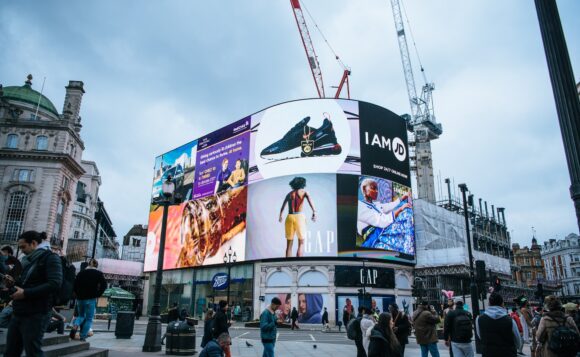
As a rule,  AR advertising is used for street campaigns: billboards and city lights with digital element activation markers for smartphones or tablets. 

Pepsi Max’s Bus Shelter is an example of an outdoor AR advertisement. It’s a bus stop with a built-in screen that demonstrates various AR scenes. While people wait for a bus, they see digital meteorites, alien ships, or underground monsters, that are superimposed on a real street in the UK. 

City Painter by Snapchat is another example of outdoor AR advertisement. Unlike the previous case, this app is developed for smartphones. A mobile device user “colors” city streets with digital paint. Using a smartphone screen, you can see the results of both your work and those of other “artists”.

Print Comes to Life: Augmented Reality Advertising on Your Merchandise

This type of augmented reality advertisement is activated by markers, like QR codes and images, placed on printed promo products: posters, flyers, business cards, booklets, magazines, etc.

For example, the Net-a-Porter fashion brand augmented their PORTER paper magazine issue with AR illustrations that are activated by smartphones right on the magazine pages. With augmented reality, PORTER readers discover exclusive content and the possibility to order a chosen item from magazine pages through a smartphone. This issue of the magazine was developed in collaboration with The UK IT company blippAR. 

A similar function is also available for National Geographic printed magazine. Using a smartphone, a reader unlocks different 3D objects and animations on magazine pages.

Unboxing Your Brand: Augmented Reality Ads on Product Packages

In this case, a product package isn’t just called to protect from outside influence. With augmented reality, a colorful and original package can be even more attractive for customers with the help of an AR experience.

Pizza Hut Pac-man AR Game is a bright example of an AR package advertisement. Every pizza package contains a marker that activates a classic video game Pac-man. But now it’s in augmented reality.

Usually, for AR package ads developers implement WebXR technology, the one we discussed in our previous article. 

Experience Your Favorite Shows and Movies in a New Way with AR Ads

Augmented reality promo campaigns made for smartphones are drawing the attention of your movie or TV show’s potential audience. A movie-based AR experience makes users mentally closer to their favorite movie heroes and attached to a movie or TV show. 

A bright example of the use of an AR smartphone app to promote the movie/TV series is The Mandalorian AR Marketing Campaign. It’s an AR program that activates a digital model of the Mandalorian himself and Baby Yoda while recreating some scenes from the show. The convenience of this AR experience is that users can unlock it while sitting on the couch at home.

The Mandalorian AR Marketing Campaign was developed by Disney, in collaboration with  Google,  as a part of a promo campaign for the second season of “Star Wars: The Mandalorian”.

Another famous case of implementing AR for TV shows promotion is a campaign for the third season of Stranger Things by Netflix. It’s a collaboration of the Netflix project with the popular newspaper, The New York Times. A user had a chance to unlock AR content with the 1980s images on newspaper pages, using a smartphone. These images are Starcourt Mall ads. It’s a fictional mall, where a part of the season three plot is happening.

It’s not the first time that Stranger Things promoters use immersive technologies for the show’s promo campaign. During the first season premiere, Netflix presented a VR experience on YouTube with fans being allowed to observe the main location of the season. 

Try Before You Buy: Augmented Reality Virtual Try-On 

AR try-on scans the human body and allows a customer to try on digital items. 

One of the most interesting use cases of implementing augmented reality for try-on is the one presented by Lacoste. In this program, a smartphone user sees both the digital model of a sneaker on their foot and a 3D installation that outlines a style of a certain shoe model.

In our article, you can read more about the technology of virtual try-on and its influence on modern retail. 

Transform Your Business with Augmented Reality Marketing

Today, modern brands pay more attention to augmented reality as a marketing tool for a few reasons, including

  • Improving brands and customer interaction.  Using augmented reality for promotion, you make your brand and products more available for modern gadget users. Nowadays, there are over 6 billion smartphone users around the world, and it’s 83% of the whole planet’s population. So, people can learn more about your brand and new product, not taking their sights off device screens. 
  • Enhancing customers’ emotional connection with brands. It has long been proven that immersive technologies can cause emotional feedback in users. It is one thing when your client reads the info about the advantages of your services or goods. Another thing is when a customer can try on digital clothes or play AR games, thus adopting an emotional connection and pleasant associations with the brand. According to Invespcro, 70% of customers claimed to be loyal to a brand that uses AR. 
  • Increasing the company’s income. Having tested your product in AI, your customers are more likely to buy a real product. 61% of online customers said they preferred to buy items on-site after AR product testing. 
  • Facilitating the possibility to provide feedback. When trying on an item’s digital version, customers have a better understanding of whether this item fits them or not. According to Harvard Business School, over 30 000 items are produced annually, and 80% of them have flaws. Augmented reality offers companies to improve customer feedback and eliminate an item’s defects. 
  • Engaging young audience. Immersive and innovative technologies are primarily an object of interest for children, teenagers, and Z-gen youth (some media even call them AR-generation). This generation has a better awareness of modern technologies. Zoomers were literally growing up with smartphones in their hands. As data for April 2022 shows, 92% of Zoomers want to use AR for their online shopping.

banner_blue

Augmented reality is a powerful tool to improve your brand’s promo.  It helps companies reach modern customers, who cannot imagine their lives without devices. Augmented reality also enhances the emotional connection between the brand and the audience and improves clients’ loyalty to a brand. Want to have a stronger connection between your brand and the audience? Start keeping up with the latest trends and implementing AI applications. It won’t take long before the result comes. 

Image: Freepik

Latest Articles
From Pain Relief to Rehabilitation: A Portrait of VR Therapeutics in 2026
May 27, 2026
From Pain Relief to Rehabilitation: A Portrait of VR Therapeutics in 2026

VR therapeutics is becoming a real category of reimbursable medicine. It now has FDA authorization pathways, dedicated billing codes, and growing support from commercial insurers. This shift didn’t happen overnight. It has built up over several years through a series of regulatory, clinical, and commercial milestones that together make 2026 a turning point for the industry. The market is starting to reflect that. Estimates vary by methodology, but SNS Insider projects the broader VR healthcare market to grow from $4.27B in 2024 to $46.4B by 2032 (a 33% CAGR). VR telerehabilitation alone is projected to grow from $1.2B in 2026 to $2.67B by 2030, a 22% CAGR that captures the segment this article focuses on. Three moments tell the story of how we got here. 2021: The first prescription VR therapy gets FDA cleared. AppliedVR’s RelieVRx became the first VR product authorized as a prescription medical device in the US. 2023: Medicare opens the reimbursement door. Centers for Medicare and Medicaid Services created the first VR-specific billing code, placing prescription VR into the Durable Medical Equipment category. The practical effect: doctors gained a way to prescribe VR therapy, and insurers gained a code to pay against. 2025: Commercial insurers begin following Medicare’s lead. In September, Cigna became one of the first major commercial payers to cover FDA-approved digital therapeutics. In this article, we’ll walk through six therapeutic domains where that infrastructure is taking shape. Each has its own clinical logic, its own leading players, and its own path to scale.  Market architecture Before we walk through the six therapeutic domains, it’s worth understanding the shape of the market they sit inside: what’s growing, where the money is concentrated, and what changed structurally between 2023 and 2025 to make any of this viable. Where therapy and rehab sits inside VR healthcare VR healthcare as a whole spans everything from surgical training simulators to anatomical education tools. But within that broader market, VR therapeutics and rehabilitation is the fastest-growing application segment, and it’s also where regulatory and reimbursement infrastructure is forming most actively. Inside therapy-and-rehab itself, two sub-segments are consistently identified by independent market research as the fastest-growing: pain management and mental health therapy. Both have something the other categories don’t yet: FDA-cleared products in the market, peer-reviewed efficacy data, and at least nascent reimbursement pathways. Geographically, the market is concentrated in two regions for very different reasons. North America is leading adoption mainly because the FDA has started approving prescription VR therapies, and dedicated billing codes now allow healthcare providers to get reimbursed for using them. Europe is catching up via different infrastructure, particularly Germany’s DiGA framework, which provides a parallel route to physician prescription and statutory health insurance coverage. France’s PECAN and the UK’s DTAC are developing in a similar direction. The pattern is clear: once regulators create a formal pathway, companies and investment tend to follow. What the hardware cycle unlocked The clinical use cases for VR therapy didn’t really change between 2020 and 2025. What changed is that the hardware finally became viable for the business models the clinical work demanded. Consumer-grade standalone headsets brought the price floor down to where at-home prescription models work. Meta Quest 3, Meta Quest 3S, and Pico 4 helped bring standalone VR headsets to more affordable consumer price levels—an important step for prescription VR therapies that patients are expected to use at home. RelieVRx, for example, is a self-administered program delivered to patients in their living rooms; that model is described in detail in MDIC’s case study of the product. Major headset manufacturers are doubling down on healthcare partnerships rather than building healthcare-specific hardware. A useful signal here is HTC VIVE’s April 2025 expansion with Mynd Immersive, Select Rehabilitation, and AT&T into more than 150 US senior living communities—the largest deployment of immersive therapeutics into senior care to date. The interesting strategic detail isn’t the size of the rollout but its structure: a hardware OEM (HTC), a content/care platform (Mynd), a clinical services partner (Select Rehab), and a connectivity provider (AT&T). That’s the four-party stack that scaled clinical VR is going to require, and partnerships like this one are essentially templates that the rest of the industry will be copying. Body: pain & physical rehab 1. Pain management Pain is the single largest unmet need in clinical medicine. In the United States alone, roughly 50 million adults live with chronic pain, and the toolkit physicians have to treat it is uncomfortably narrow: opioids carry addiction risk, non-opioid pharmaceuticals are inconsistently effective, and behavioral therapies are scarce and slow. Procedural pain is its own category, often managed with anesthesia or sedation, which adds cost, risk, and recovery time. This is the gap VR fills. The clinical evidence for VR as a pain intervention rests on two well-documented neurological mechanisms. The first is gate control theory: pain signals traveling up the spinal cord compete with other sensory inputs for processing capacity, and immersive visual and auditory stimulation can effectively crowd them out before they reach the brain as pain. The second is cognitive load: a fully immersive VR experience occupies enough of that capacity to leave less available for processing pain as pain. Together, these mechanisms make VR more than just a distraction. They turn it into a real neurological intervention, which helps explain why VR can reduce pain in clinical settings where simpler distractions like music or conversation often cannot. There are two distinct applications emerging from this. The first is procedural pain, where Medtronic provides the clearest commercial example. Medtronic’s VR solution makes office hysteroscopy more comfortable by immersing the patient in a virtual environment during the procedure. According to Medtronic, the immersive sedation-analgesia content reduces patient anxiety and decreases pain-related brain activity. The second application is chronic pain. RelieVRx, which we talked about above, is a shining example, receiving Breakthrough Device Designation and De Novo authorization specifically for chronic lower back pain. A regulatory pathway the AppliedVR team has documented in detail in the peer-reviewed literature. The clinical data behind…

How Extended Reality Is Reshaping Modern Marketing
March 31, 2026
How Extended Reality Is Reshaping Modern Marketing

The global extended reality market (including VR, AR and MR) is expected to reach $84.86 billion by 2029, growing at an estimated annual rate of 28%. But the bigger point isn’t just that the market is expanding, it’s that XR is already proving its value in the places marketers care about most: engagement, conversion, and customer confidence. In ecommerce, interacting with products via AR leads to a 94% higher conversion rate compared to products without AR. That makes sense: when people can better understand what they’re buying, they’re more likely to move forward and less likely to regret the purchase later.  XR also gives brands something that’s getting harder to win online: attention. VR campaigns generate about 46% higher engagement than traditional digital campaigns. People who interact with AR content spend around 2.7 times longer on product pages.  XR is now showing up in real results. That is why marketing is moving beyond static content toward immersive experiences. In the following sections, we will share how these technologies can be applied to marketing strategies and explore what the future of immersive experiences might look like. How XR is transforming modern marketing: 4 use cases that prove it works With XR, businesses can turn traditional campaigns into fully immersive experiences, where customers can explore products, interact with brands, and connect with content in memorable ways. Its value goes far beyond visual appeal, directly impacting the business growth and customer journey itself. And while this may not be immediately obvious, XR can also save significant resources, reducing the need for physical prototypes, showrooms, or large-scale events, making marketing more efficient. This is why more businesses are integrating immersive technologies into their marketing strategies, even despite certain challenges, such as development and VR hardware costs, as well as complex technology integration. Below, we highlight several successful use cases of immersive technologies in marketing. Virtual try-ons One of the most persistent barriers to online purchasing is uncertainty. Will these glasses suit my face shape? Will this sofa fit in my living room? Will this shade of lipstick actually complement my skin tone? These are questions that traditionally required a physical store visit. Virtual try-on eliminates that leap entirely. The technology behind this falls into a few distinct forms. The most accessible is smartphone-based AR. Customers point their phone at themselves or their surroundings, and the app overlays a true-to-scale digital product in real time. A striking example is the FindYourGlasses app developed by Qualium Systems. A step further are dedicated AR headsets and glasses, which immerse the customer in a mixed-reality environment where products can be explored in even greater depth and spatial accuracy.  These technologies help customers understand what they are buying before making a purchase, enabling them to make decisions based on accurate, personalized visualization rather than guesswork. Real-world example: IKEA Place AR App IKEA Place AR app lets shoppers visualize furniture in their own physical spaces before buying. Customers simply point their phone camera at a room, select a piece of furniture, and see it rendered in realistic scale within their actual environment. This removes the biggest friction point in furniture shopping: not knowing whether a sofa or shelf will actually fit or match the existing interior design. Results: After launch, the app was downloaded millions of times and became one of the most widely adopted retail AR experiences globally. IKEA reported increased customer engagement and reduced returns because customers could see how items fit before purchase. The company reported also that customers who use the IKEA Place app are 11% more likely to complete a purchase compared to those who do not use the app. Virtual showrooms & Tours Some purchases simply feel too significant to make without experiencing the space or context first. Traditionally, that meant showing up in person. Virtual showrooms and immersive tours remove that requirement. The technology here ranges from 360° web-based tours (viewable in any browser without additional hardware) to fully immersive VR experiences delivered through headsets. Visitors can walk through a branded space, interact with products, and access information on demand, without leaving their couch or office. Automotive brands use virtual showrooms to let buyers explore vehicle interiors, switch trims and colors, and get a feel for the cabin before visiting a dealership. Real estate platforms offer immersive property walkthroughs that let buyers shortlist homes remotely. Hotels and resorts use virtual tours to sell the experience upfront.  The value is especially pronounced in the machinery and heavy equipment sector, where physically demonstrating a product has always been costly: shipping industrial equipment to trade shows, organizing on-site demos, and flying prospects to manufacturing facilities all consume significant budgets. VR removes that overhead entirely: a potential buyer can step inside a virtual factory floor, operate a machine in a simulated environment, and evaluate complex equipment in full detail. Real-world example: Virtual showroom for MAKEEN Energy industrial equipment MAKEEN Energy, a global corporation delivering industrial gas solutions and heavy infrastructure equipment, built a true-to-scale virtual showroom. Using 3D models of their equipment in a virtual environment, they were able to pack their sprawling machinery into a portable VR headset and bring it to any trade fair.  Results: By no longer shipping heavy equipment around the world and reducing travel with virtual product demonstrations, MAKEEN Energy was able to cut logistics costs significantly. The virtual showroom also accelerated complex, multi-stakeholder sales by giving engineers, technicians, and purchase managers across different countries a shared, detailed view of the product. What began as a trade fair tool evolved into a company-wide asset for sales, training, and communications. For industrial businesses looking to adopt XR, Qualium Systems serves as a trusted technology partner, delivering VR and Web3D solutions that simplify the presentation of complex equipment, enhance product understanding, and support more effective digital engagement. Immersive brand storytelling XR gives brands the ability to place customers at the center of a narrative, transforming passive content consumption into a first-person experience that is far harder to forget. A VR film or AR…

September 10, 2025
Immersive Technology & AI for Surgical Intelligence – Going Beyond Visualization

Immersive XR Tech and Artificial Intelligence are advancing MedTech beyond cautious incremental change to an era where data-driven intelligence transforms healthcare. This is especially relevant in the operating room — the most complex and high-stakes environment, where precision, advanced skills, and accurate, real-time data are essential. Incremental Change in Healthcare is No Longer an Option Even in a reality transformed by digital medicine, many operating rooms still feel stuck in an analog past, and while everything outside the OR has moved ahead, transformation has been slow and piecemeal inside it. This lag is more pronounced in complex, demanding surgeries, but immersive technologies convert flat, two-dimensional MRI and CT scans into interactive 3D visualizations. Surgeons now have clearer spatial insight as they work, which reduces the risk of unexpected complications and supports better overall results. Yet, healthcare overall has changed only gradually, although progress has been made over the course of decades. Measures such as reducing fraud, rolling out EMR, and updating clinical guidelines have had limited success in controlling costs and closing quality gaps. For example, the U.S. continues to spend more than other similarly developed countries. Everything calls for a fundamental rethinking of how healthcare is structured and delivered. Can our healthcare systems handle 313M+ surgeries a year? Over 313 million surgeries will likely be performed every year by 2030, putting significant pressure on healthcare systems. Longer waiting times, higher rates of complications, and operating rooms stretched to capacity are all on the rise as a result. Against this backdrop, immersive XR and artificial intelligence are rapidly becoming vital partners in the OR. They turn instinct-driven judgement into visual data-informed planning, reducing uncertainty and supporting confident decision-making. The immediate advantages are clear enough: shorter time spent in the operating room include reduced operating-room time and lower radiation exposure for patients, surgeons, and OR staff. Just as critical, though less visible, are the long-term outcomes. Decreased complication rates and a lower likelihood of revision surgeries are likely to have an even greater impact on the future of the field. These issues have catalyzed the rise of startups in surgical intelligence, whose platforms automate parts of the planning process, support documentation, and employ synthetic imaging to reduce time spent in imaging suites. Synthetic imaging, for clarity, refers to digitally generated images, often created from existing medical scans, that enrich diagnostic and interpretive insights. The latest breakthroughs in XR and AI Processing volumetric data with multimodal generative AI, which divides volumes into sequences of patches or slices, now enables real-time interpretation and assistance directly within VR environments. Similarly, VR-augmented differentiable simulations are proving effective for team-based surgical planning, especially for complex cardiac and neurosurgical cases. They integrate optimized trajectory planners with segmented anatomy and immersive navigation interfaces. Organ and whole-body segmentation, now automated and fast, enables multidisciplinary teams to review patient cases together in XR, using familiar platforms such as 3D Slicer. Meanwhile, DICOM-to-XR visualization workflows built on surgical training platforms like Unity and UE5 have become core building blocks to a wave of MedTech startups that proliferated in 2023–2024, with further integrations across the industry. The future of surgery is here The integration of volumetric rendering and AI-enhanced imaging has equipped surgeons with enhanced visualization, helping them navigate the intersection of surgery and human anatomy in 2023. Such progress led to a marked shift in surgical navigation and planning, becoming vital for meeting the pressing demands currently facing healthcare systems. 1) Surgical VR: Volumetric Digital Twins Recent clinical applications of VR platforms convert MRI/CT DICOM stacks into interactive 3D reconstructions of the patient’s body. Surgeons can explore these models in detail, navigate them as if inside the anatomy itself, and then project them as AR overlays into the operative field to preserve spatial context during incision. Volumetric digital twins function as dynamic, clinically vetted, and true-to-size models, unlike static images. They guide trajectory planning, map procedural risks, and enable remote team rehearsals. According to institutions using these tools, the results include clearer surgical approaches, reduced uncertainty around critical vasculature, and greater confidence among both surgeons and patients. These tools serve multidisciplinary physician teams, not only individual users. Everyone involved can review the same digital twin before and during surgery, working in tight synchronization without the risk of mistakes, especially in complex surgeries such as spinal, cranial, or cardiovascular cases. These pipelines also generate high-fidelity, standardized datasets that support subsequent AI integration, as they mature. Automated segmentation, predictive risk scoring, and differentiable trajectory optimizers can now be layered on top, transforming visual intuition into quantifiable guidance and enabling teams to leave less to chance, delivering safer and less invasive care. The VR platform we built for Vizitech USA serves as a strong example within the parallel and broader domain of healthcare education. VMed-Pro is a virtual-reality training platform built to the standards of the National Registry of Emergency Medical Technicians; the scenarios mirror real-world protocols, ensuring that training translates directly to clinical practice. Beyond procedural skills, VMed-Pro also reinforces core medical concepts; learners can review anatomy and physiology within the context of a virtual patient, connecting textbook knowledge to hands-on clinical judgment. 2) Surgical AR: Intra-operative decision making Augmented reality for surgical navigation combines real-time image registration, AI segmentation, ergonomically designed head-worn glasses, and headsets to convert preoperative DICOM stacks into interactive holographic anatomy, giving surgeons X-ray visualization without diverting gaze from the field – a true Surgical Copilot right in the OR. AI-driven segmentation and computer-vision pipelines generate metric-accurate volumetric models and annotated overlays that support trajectory planning, instrument guidance, and intraoperative decision support. Robust spatial registration and tracking (marker-based or depth-sensor aided) align holograms with patient anatomy to submillimetre accuracy, enabling precise tool guidance and reduced reliance on fluoroscopy. Lightweight AR hardware, featuring hand-tracking and voice control, preserves surgeon ergonomics and minimizes distractions. Cloud and on-premises inference options balance latency and computational power to enable real-time assistance. Significant industry investment and agile startups have driven integration with PACS, navigation systems, and multi-user XR sessions, enhancing preoperative rehearsal and team…


Let's discuss your ideas

Contact us